

Smart Hospital Market Revenue Expected to Reach USD 404.35 Billion by 2035 at 16.6% CAGR
Smart Hospital Market
Smart Hospital Market Size, Share and Research Report By Type (General Services, Specialty, Super-Specialty), By Application (Remote Medicine Management
Smart Hospital Market: Driven by the integration of IoT, AI, and connected devices to optimize patient care and streamline clinical workflows.”
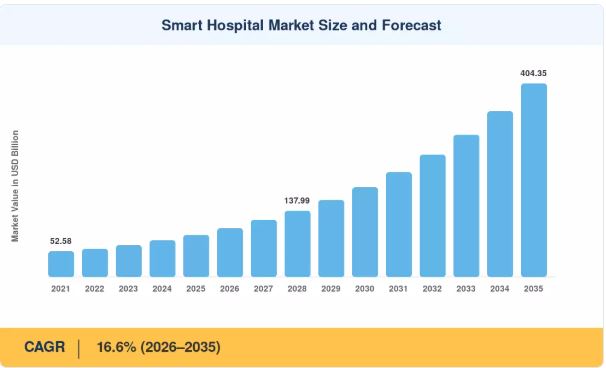
NEW YORK,, NY, UNITED STATES, September 3, 2026 /EINPresswire.com/ -- The Global Smart Hospital market reached USD 87.05 billion in 2025 and opens the forecast window at USD 101.50 billion in 2026, climbing to USD 404.35 billion by 2035 at a 16.6% CAGR. Two catalysts anchor that trajectory. The first is regulatory: information-blocking penalties and mandated FHIR-based application programming interfaces have forced hospital systems to open data that once sat locked inside departmental silos. — Market Research Future (MRFR)
The second is fiscal sovereign digitisation funds across Asia and the Gulf now underwrite capital that individual hospitals could never justify alone. The market's expansion reflects the convergence of national interoperability and data-sharing mandates (~2.9% impact), clinical labour shortages driving automation (~2.6%), ageing populations and chronic disease burden (~2.4%), and low-latency clinical networking via 5G and early 6G (~2.1%) accelerating across the world's largest healthcare-regulatory and digital-infrastructure economies simultaneously.
The Smart Hospital Market is rapidly expanding as healthcare providers adopt artificial intelligence (AI), Internet of Things (IoT), connected medical devices, cloud computing, robotics, automation, and advanced data analytics to create more efficient and patient-centric healthcare environments. Current industry estimates vary by market definition, with recent forecasts indicating strong double-digit growth through the next decade.
A smart hospital is a healthcare facility that uses interconnected digital technologies to improve patient care, streamline clinical workflows, optimize resources, and strengthen operational decision-making. Smart hospitals integrate technologies such as electronic health records, connected patient-monitoring systems, smart beds, medical imaging, RFID, cloud platforms, AI, robotics, and real-time location systems.
Get Full PDF Sample Copy of Report: (Including Full TOC, List of Tables & Figures, Chart) @
https://www.marketresearchfuture.com/sample_request/4505
➤ How Significant Is the Smart Hospital Market's Growth?
The smart hospital market's trajectory from USD 87.05 billion in 2025 to a projected USD 404.35 billion by 2035 represents more than a four-and-a-half-fold expansion over the forecast decade, reflecting the structural shift from paper charting, isolated nurse-call panels, and pneumatic-tube pharmacy logistics toward integrated clinical platforms, sensor-instrumented beds, robotic dispensing cabinets, and real-time location networks. The market's 16.6% CAGR is anchored in a compliance-and-labour supercycle where interoperability mandates, clinical staffing shortages, and reimbursement expansion for remote monitoring are all converging to make connected hospital infrastructure a board-level capital priority rather than a discretionary IT upgrade.
Hardware commanded 42.6% of the market in 2025, led by sensor-instrumented beds, edge gateways, and clinical-grade wireless infrastructure, while services are projected to expand at a 19.5% CAGR through 2035 as hospitals migrate from capital purchases to managed partnerships with per-bed subscription contracts now routinely spanning seven to ten years. Software contributed USD 27.16 billion in 2025 across clinical decision support, orchestration, and analytics layers.
By application, Electronic Health Record deployments held a 26.5% revenue share in 2025 as a maturing replacement market rather than a growth engine, while Remote Patient Monitoring is forecast to advance at a 20.7% CAGR to 2035, the fastest of any application, since each enrolled patient generates recurring device, connectivity, and analytics revenue that a one-time record migration never will. Pharmacy Automation generated USD 15.06 billion in 2025, driven by medication-error liability. By end user, Private Hospitals hold a 47.8% share through competitive differentiation, while Specialty Clinics and Ambulatory Surgical Centres are the fastest-growing segment at an 18.9% CAGR as procedures migrate out of acute settings.
➤ What Does the Future Hold for the Smart Hospital Market?
National interoperability and data-sharing mandates contribute approximately 2.9 percentage points to the smart hospital market's CAGR the single highest driver impact. Regulators discontinued their courteous inquiries: as certified API conformance deadlines passed, enforcement referrals increased significantly through 2024, and civil monetary penalties for violating the information-blocking provisions of the 21st Century Cures Act run as high as USD 1 million per violation. Hospitals discovered that the cost of replacing a 15-year-old core system was nearly as high as the cost of attaching a compliance gateway onto it, redirecting budget toward platform-native architectures instead.
Clinical labour shortages driving automation contribute approximately 2.6 percentage points to the CAGR, establishing staffing mathematics as a primary capital-committee driver. The World Health Organization anticipates a shortage of approximately 10 million health workers by 2030, with acute-care nursing among the most vulnerable categories, and robotic dispensing, automated documentation, and closed-loop medication administration have been justified solely on the basis of labor offset, targeting repayment within 30 months at facilities with vacancy rates around 18-22%.
Ageing populations and chronic disease burden add a further 2.4% as Europe and Asia-Pacific face structurally rising care demand, while low-latency clinical networking contributes a further 2.1% as early 6G pilot deployments in Japan and South Korea have demonstrated sub-millisecond round-trip latency inside hospital campuses, enough to support closed-loop ventilator adjustment and remote surgical assistance, changing clinical software design assumptions permanently wherever bandwidth stops being scarce.
Reimbursement expansion for remote monitoring further reinforces the trend, as expanded remote physiologic monitoring codes lifted qualifying billable encounters by more than 42% between 2022 and 2024 in the United States, converting monitoring from a cost centre into a revenue line.
The next phase of the market's evolution centers on autonomous clinical operations, as agentic software moves from suggestion to execution; by 2032, scheduling, supply replenishment, and discharge coordination are expected to run with limited human confirmation, cutting administrative overhead, currently 24-31% of hospital operating cost, by roughly a third in mature deployments. Platform economics and vendor consolidation are arriving late but decisively, as hospitals want fewer contracts and integration-layer ownership becomes the defensible competitive position, a dynamic expected to compress the vendor field materially by 2030.
Care delivery is also moving beyond the building, with hospital-at-home programmer reaching roughly 380 approved US sites by 2025 and continuing to expand in Australia and the Nordics, meaning monitoring infrastructure rather than beds becomes the constraint on capacity. Sustainability and energy reporting are quietly becoming standard requirements as healthcare accounts for approximately 4.6% of global greenhouse emissions, and building-management integration is increasingly specified in the same tenders as clinical systems.
Get access to the full description of the report @
https://www.marketresearchfuture.com/reports/smart-hospital-market-4505
➤ Who Are the Key Players in the Smart Hospital Market?
Concentration in the smart hospital market sits in the medium band. The estimated Herfindahl-Hirschman Index falls between 780 and 940, with the top five suppliers accounting for roughly 34-39% of global revenue. That structure reflects genuine heterogeneity, as no single vendor credibly spans beds, networks, records, pharmacy robotics, and building systems, so partnerships and selective acquisition define competitive strategy more than direct feature rivalry. MRFR identifies the following key participants with estimated revenue share ranges:
Koninklijke Philips (~8–11% share) - the monitoring incumbent moving to subscription, providing patient monitoring, tele-ICU, and clinical informatics, having expanded its acute-care telehealth platform in March 2024 to support multi-site command centres for health systems consolidating monitoring across dispersed facilities.
Siemens Healthineers (~7–10% share) - a diagnostics-anchored platform play, providing imaging integration, diagnostics IT, and workflow orchestration, leveraging its deep imaging installed base to anchor broader clinical-workflow platform sales.
GE HealthCare (~6–9% share) - an operational-efficiency specialist, providing command centres, asset tracking, and care orchestration, having acquired the remaining stake in a care-orchestration software venture in November 2024 to consolidate command-centre capability under direct ownership.
Oracle Health (~6–8% share) - a records-to-cloud consolidation leader, providing electronic records and a cloud data platform, having announced a rebuilt cloud-native electronic record with embedded clinical agents in September 2024, signalling intent to own the automation layer rather than cede it.
Cisco Systems (~5–7% share) - the connectivity and zero-trust layer provider, offering clinical networking, segmentation, and device security, having released medical-device attestation tooling in February 2025 addressing underwriter demands for connected-asset visibility after a sustained ransomware wave.
Medtronic (~4–6% share) - a device-led data capture specialist, offering connected devices and closed-loop therapy platforms, positioned to convert its device installed base into recurring clinical-data revenue streams.
Honeywell International (~3–5% share) - a facility-infrastructure convergence specialist, offering building management, air quality, and RTLS, serving hospitals increasingly specifying energy telemetry in the same tenders as clinical systems.
Johnson Controls International (~3–5% share) - a smart-building specialist, offering environmental controls and security integration, serving customers requiring converged facility and clinical-security infrastructure.
Baxter International / Hillrom (~3–5% share) - a bedside hardware footprint leader, offering smart beds, nurse call, and vital-sign connectivity, having launched a connected bed platform with open telemetry interfaces in August 2025, responding to hospital resistance against proprietary bedside ecosystems.
Microsoft (~3–4% share) - the hyperscaler enablement layer, offering cloud health data services and ambient documentation, positioned to serve hospitals adopting voice-first clinical documentation and cloud-native health data platforms.
Strategic competition in the smart hospital market is increasingly defined by integration-layer ownership and managed-service tenure rather than point-product feature rivalry, with ransomware exposure and cyber-insurance costs cited as a top structural headwind, contributing an estimated -1.7% drag on CAGR as average recovery cost per healthcare breach reached USD 9.7 million in 2024 and boards now demand segmentation architecture and device-attestation evidence before signing, lengthening sales cycles by four to seven months, alongside legacy system fragmentation and integration cost, thin operating margins at community hospitals where roughly 37% reported negative operating margins in 2024, clinician resistance and change-management failure, and cross-border data residency restrictions.
➤ What Are the Emerging Trends in the Smart Hospital Market?
Several transformational trends are redefining the smart hospital market's evolution through 2035:
Managed Services as the Dominant Commercial Model: Hospitals increasingly prefer availability guarantees to asset ownership, with vendors packaging devices, integration, monitoring, and refresh into a single per-bed monthly fee capturing longer contract tenure and materially better renewal economics, the structural reason services outgrow hardware across the market.
Emerging-Market Greenfield Deployments: India's national digital health mission has issued more than 700 million health account identifiers, and new tertiary facilities across ASEAN and the Gulf are specifying integrated platforms at design stage rather than retrofitting, allowing greenfield sites to skip a full technology generation.
Clinical Data Monetisation and Real-World Evidence: De-identified longitudinal datasets have acquired standalone commercial value, with health systems partnering with life-sciences sponsors on real-world evidence programmes now reporting ancillary revenue equal to 1.5-3% of operating income, funding further digital investment without new capital requests.
Ambient Documentation and Autonomous Workflow: Voice-first clinical documentation moved from pilot to procurement, with early deployments showing 42-58 minutes of documentation time returned per clinician per shift, a benefit large enough to survive budget scrutiny even in constrained systems.
Buy Full Research Report:
https://www.marketresearchfuture.com/checkout?currency=one_user-USD&report_id=4505
➤ How Is the Smart Hospital Market Segmented?
The smart hospital market report provides a comprehensive segmentation framework:
By Component: Hardware (42.6% share, 2025), Software (USD 27.16 billion, 2025), Services (19.5% CAGR)
By Application: Electronic Health Record (26.5% share, 2025), Remote Patient Monitoring (20.7% CAGR), Pharmacy Automation (USD 15.06 billion, 2025), Medical Asset Tracking (14.6% share, 2025), Others — Smart Beds, Wayfinding, OR Integration (USD 17.58 billion, 2025)
By Type: General Services, Specialty, Super-Specialty
By End User: Private Hospitals (47.8% share, 2025), Public / Government Hospitals (USD 28.11 billion, 2025), Specialty Clinics & Ambulatory Surgical Centres (18.9% CAGR), Academic Medical Centres (7.3% share, 2025)
By Region: North America (38.0% share, 2025), Europe (USD 26.46 billion, 2025), Asia-Pacific (18.4% CAGR), South America (5.2% share, 2025), Middle East & Africa (USD 4.00 billion, 2025)
➤ Major Challenges:
High Initial Investment: Smart hospital transformation requires substantial investment in hardware, software, connectivity, cybersecurity, integration, and employee training. Smaller healthcare facilities may find these investments difficult to manage.
Legacy Infrastructure: Many hospitals continue to operate older IT and medical systems. Integrating new technologies with legacy infrastructure can be complex and costly.
Cybersecurity Risks: Greater connectivity creates additional cybersecurity exposure. Connected medical devices, hospital networks, and patient databases can become targets for cyberattacks, making security a critical part of smart hospital planning.
Data Privacy: Smart hospitals generate and exchange large quantities of sensitive healthcare information. Organizations therefore need strong data governance, access controls, encryption, and privacy practices.
Interoperability: Healthcare technologies from different vendors do not always communicate seamlessly. Interoperability remains essential for creating truly connected hospital environments.
➤➤➤ Industry Analysis Reports by Market Research Future:
LED and OLED Display Market
https://www.marketresearchfuture.com/reports/led-oled-display-market-1096
Safety Light Curtains Market
https://www.marketresearchfuture.com/reports/safety-light-curtains-market-5914
Near Field Communication (NFC) Market
https://www.marketresearchfuture.com/reports/global-near-field-communication-market-1590
3D IC Market
https://www.marketresearchfuture.com/reports/3d-ic-market-1763
KVM Switch Market
https://www.marketresearchfuture.com/reports/kvm-switch-market-7716
Smart Beacon Market
https://www.marketresearchfuture.com/reports/smart-beacon-market-8181
Smart Speakers Market
https://www.marketresearchfuture.com/reports/smart-speaker-market-2286
Walkie Talkie Market
https://www.marketresearchfuture.com/reports/walkie-talkie-market-4347
Smart Shoe Market
https://www.marketresearchfuture.com/reports/smart-shoe-market-4524
AR and VR Smart Glasses Market
https://www.marketresearchfuture.com/reports/ar-vr-smart-glasses-market-4837
Market Research Future
Market Research Future
+1 855-661-4441
email us here
Legal Disclaimer:
EIN Presswire provides this news content "as is" without warranty of any kind. We do not accept any responsibility or liability for the accuracy, content, images, videos, licenses, completeness, legality, or reliability of the information contained in this article. If you have any complaints or copyright issues related to this article, kindly contact the author above.
